Basic HTML Version



achieving competence in real world science
How do glaciers move?
thin layer of water. This reduces
friction
enou-
gh that the glacier can slide down the slope.
Speed record
A glacier flows because the highly
compressed layers of ice are very
flexible under great pressure. Most
glaciers move just millimeters each
year. The world’s fastest glacier is the
Jakobshavn Glacier in Greenland,
which in the last decade has more
than doubled its old speed (that was
already very high!), reaching the value
of 12,600 meters per year.
Glaciers shape landscapes
The Antarctic ice cap is so heavy that
it compresses the Earth at the south
pole. As a result, Earth is slightly pear-shaped,
with the south pole flatter than the north pole.
Alpine glaciers move through valleys, flatte-
ning the valley floors as they go. The result is
a U-shaped valley instead of the usual sharp
V-shape. The inexorable force of glaciers carves
out lakes, grinds down mountains, scatters stran-
ge rock formations across the countryside and
reduces solid rock to fine dust.
Answer the questions
How can a glacier slip on its base?
Scientists think that Jakobshavn Glacier
sped up in the last decade because it got thin-
ner. What is, in your opinion, the reason why
the lighter a glacier gets, the faster it moves?
(Suggestion: think how friction works.)
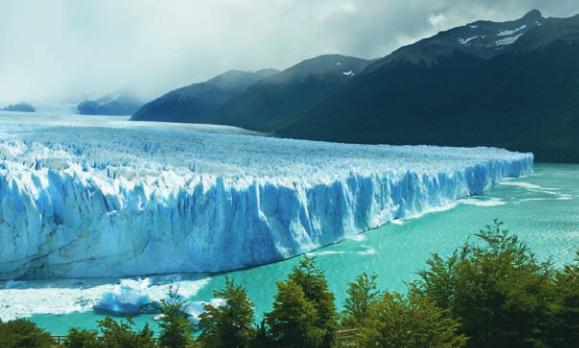
Glaciers are massive rivers of ice that form in
areas where more snow falls each winter than
melts each summer.
Glacier formation
As more and more snow piles up over the years,
the
weight
of the snow on top starts to compress
the snow on the bottom. This compression turns
the snow to ice.
Two types of movement
The compression of the glacier continues for
hundreds and thousands of years, adding more
and more layers and adding even more weight.
Eventually, the glacier becomes so heavy that it
starts to move. It displays two types of
move-
ment
:
•
Spreading (gradual horizontal expansion)
occurs when the glacier’s own weight becomes
too much for it to support itself.
•
Basal slip occurs when the glacier rests on a
slope. Pressure causes a small amount of ice
at the bottom of the glacier to melt, creating a
2
Il moto in due e tre dimensioni
Il moto rettilineo, e in generale il moto che si svolge su un tracciato presta-
bilito (strada, pista, binario ecc.), è un moto unidimensionale: per identi-
ficare la posizione lungo il tracciato è sufficiente assegnare il valore a una
singola coordinata. In molti casi, invece, i punti accessibili all’oggetto in
moto sono quelli di un piano o di una porzione dello spazio tridimensio-
nale
[
fig. 12
]
.
001_058_CaforioSCI_U1_V1.indd 18
16/11