Basic HTML Version


1
Charge in motion is current
!
A
s we have seen in the previous pages, a charge
is the result of work done in separating electrons
and protons and it has a potential that is the amount
of work it is ready to give back. Fundamentally, the
quantity of any charge is measured by its force of
attraction or repulsion.
Indeed, any charge has the potential
to do the work of moving another
charge, either
1
by attraction or by
repulsion.
When one charge is different
from the other, there is always a
difference of potential between
them.
Two unlike charges have a
difference of potential
.
When the potential difference between
two charges forces a third charge
to move, the charge in motion is an
electric current.
Current is a continuous
flow
of electrons. To produce
current, therefore, a charge
must be moved by a potential
difference. For example, in a solid
material, such as a copper wire, the
free electrons are charges that can
be forced to move with relative
ease by a potential difference.
This current is a drift
2
of electrons that moves through
the
wire
from the point of negative charge at one end
and returns to the positive charge at the other end.
This charge in motion is the current. With more
electrons drifting through the wire, the charge of many
electrons moves and gives more current.
The number of free electrons that can be forced to
drift
3
through the wire to produce the moving charge
depends upon the amount of potential difference across
the wire. With more applied voltage, the forces of
attraction and repulsion can make more free electrons
drift, producing more charge in motion.
A larger amount of charge moving with the same
speed means a higher value of current. If less voltage
is applied across the same wire the result is a
smaller amount of charge in motion, i.e. a
smaller value of current. With zero potential
difference across the wire, there is no current.
This difference of potential is measured in
Volts, that is, the work needed to move an
electric charge. The potential difference is
often called voltage too; it is the potential
difference between two points – two
terminals. When the charge moves at the
rate of 6.25 x 10¹⁸ electrons flowing past
a given point per second, the value of
the current is one ampere. This is the
same as a coulomb of charge per
second
4
.
The ampere unit of current was
named after a scientist André M.
Ampère (1775-1836).
When the chargemoves, usually, in
a conductor, the current I indicates
the intensity of the electricity in
motion. This characteristic is a
fundamental definition of current
I = Q/ T
where I is the current in amperes, Q is in coulombs,
and the T is time, in seconds (s).
1
either… or
: one thing or the other of two things
2
drift (n.)
: flow
3
to drift (v.)
: to move, to go towards
4
per second
: each second, every single second
Electric Current
15
Brainstorming
Before reading Text 4, match these words to their translations.
16
While reading, look for the words in Exercise 15 and find their most suitable meanings in the
context of the passage. Then circle the key-words of the main points and list them.
Then translate the key-words into Italian.
TEXT 4
1
drift (v./n.)
2
wire (n.)
3
flow (v./n.)
4
repel (v.)
5
row (n.)
a
respingere
b
andare alla deriva, essere spinti dalla corrente/flusso
c
filo (di rame)
d
fila
e
scorrere/flusso
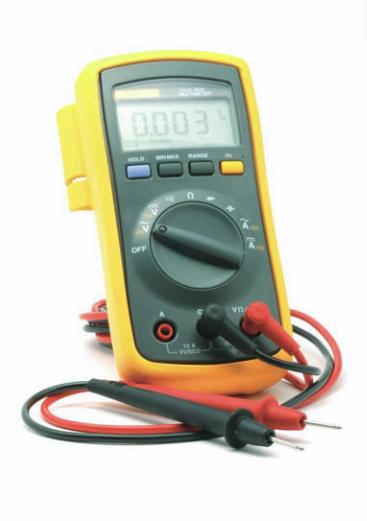
Digital multimeter (
aka
multitester): to
measure electric voltage (V), current
(A) and resistance (Ω - Ohm).
flow
flusso
potential difference/difference of potential
differenza di potenziale
wire
filo (di rame)
TECHNICAL ENGLISH
Progetto FOR ELECTRONICS_unit_1.indd 13
10/01/