Basic HTML Version















NEED HELP.
I’ve got to write a project. It’s about schools in Japan. What’s life
like in a Japanese school? Help please!!!!!!!!!!!!!!!!!!!
Posted by
kayla
on May 24, 2012 at 3:50 pm
I know that Japanese secondary students study typical subjects – maths, English,
history, chemistry, biology, PE. A student normally studies ten to fourteen subjects.
The first class starts at half past eight. There are about 30 students in each class.
Posted by
Dave123
on May 25, 2012 at 4:55 pm
Japanese students are in the same classroom all day. Boring! The teacher goes
from one classroom to another at the start and end of the class, not the students.
I hope this is useful.
Posted by
Pirate14
on May 25, 2012 at 6:20 pm
Pirate14 is right. And at the start and end of class, students stand for the teacher.
When the teacher goes, the students talk with their friends for ten minutes and take
their books out of their desks for the next class.
Posted by
wilso398
on May 27, 2012 at 9:42 am
Japanese students have lunch in their classroom. They have a cold lunch, made
at home by their parents, or they have a hot lunch made at school. Lunch is 45
minutes and there is no other break, except the ten minutes at the end of the class.
Posted by
Dave123
on May 28, 2012 at 5:35 pm
HOMEWORK HELP FORUM
1
SPEAKinG
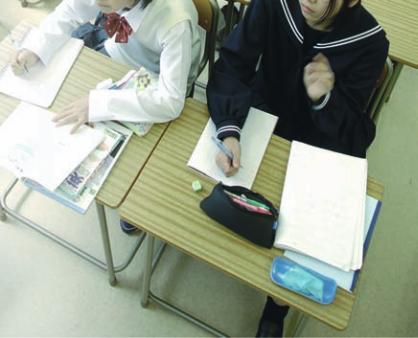
Work in pairs. Look at the photo and
answer the questions.
1
Who is in the photo?
2
Is the school similar to your school?
We aren’t in the same classroom all day.
We start at half past eight, like in Japan.
2
read the text. What’s your opinion of school life in
Japan?
a
I think it’s great.
b
I think it’s good.
c
It’s OK.
d
I don’t like it.
THANK YOU SO MUCH I REALLY APPRECIATE IT!!!!!!!!!
Posted by
kayla
on May 29, 2011 at 7:08 pm
3
read the text again. Are these sentences true (T)
or false (F) or is the information not mentioned
(nM) in the text?
1
Japanese students have very unusual school
subjects.
T/F/NM
2
In PE classes, they have 45 students with
one teacher.
T/F/NM
3
The students stand for the teacher at the start
of the lesson.
T/F/NM
4
The students answer ten questions in a class.
T/F/NM
5
The students have lunch in the school
cafeteria.
T/F/NM
6
Japanese students do homework at six o’clock.
T/F/NM
4
Match the underlined words in the text with these
definitions.
1
equal to something
2
not hot
3
normal, usual
4
something that helps
5
SPEAKinG
What about you?
What things in Japanese schools are similar to your school
and what things are different?
rEADinG
Exam Success
In
True/False/Not mentioned
activities, remember …
To answer the questions, look for the information in
the text. Do not answer with your opinion.
reading Tips
➜
page 44
Mini Dictionary
boring:
noioso
(to) take the book out:
tirare fuori il libro
unit
1
V1_U1_p024-033_bz3.indd 25
14/12/