Basic HTML Version






Sezione C
L’atomo da Dalton a Bohr
40
Chemistry Readings
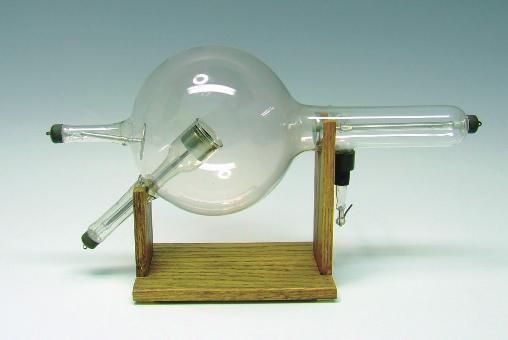
X-ray tube.
Why are the electronic shells named K, L, M…?
X-rays were discovered In the early twentieth century during the studies of
the cathodic ray. Their names were of capital importance for attributing
the names to the electronic shells.
What are X-rays?
When a metal plate is bombarded with a beam of fast-moving electrons,
the atoms of the target emit X-rays. They are high frequency electromag-
netic waves and their origin is due to the particular interaction between the
electronic beam and the atoms that are hit. In the impact an inner electron
is excited far from the nucleus and when it is recaptured, a great deal of
energy is released in the form of X-rays, whose frequency is related to the
element involved.
Different types
The first X-rays discovered seemed to be of two types. One type was able to penetrate sheets
of metal of a certain thickness; the other wasn’t. Initially the scientist who found this named
the more penetrating type A and the less penetrating type B. But they expected that even
more penetrating types of X-ray radiation would be discovered for other elements, so they
renamed them K and L to leave room for more penetrating types A through J. Anyhow these
more penetrating radiations were never observed, and the names remained unchanged.
Letters and shells
It became clear that an X-ray of K type was produced when electrons knocked out of the
n
=
1 shell are recaptured. L radiation is produced when electrons knocked out of the
n
=
2 shell are recaptured. For this reason the electronic levels took name from the types
of X-rays that were generated during the bombardment. Since the n
=
2 shell has higher
energy than the n
=
1 shell, less energy is released and L radiation is weaker (less able to
penetrate metals) than K radiation.
Fill in the blanks
When a metal plate is bombarded with a beam of
…....................………………..
electrons, the atoms of the target emit X-rays.
One type of X-ray was able to penetrate sheets of
…....................………………..
of a certain thickness.
It became clear that an X-ray of K type was produced when electrons knocked out of
…....................……………
are recaptured.
Verso le competenze
Nell’atomo si individuano quindi diversi livelli di energia, a ciascuno dei
quali appartengono una o (a partire dal secondo livello) più orbite (o sotto-
livelli) vicine tra loro che gli elettroni possono percorrere.
In seguito, altri problemi nell’interpretazione degli spettri imposero l’intro-
duzione, dovuta al fisico austriaco
Wolfgang Pauli
(1900-1958), di un nuovo
numero quantico, collegato alla rotazione dell’elettrone su sé stesso (
spin
),
fenomeno che influisce sull’energia dell’orbita (
Figura 16
).
Il nuovo modello atomico che si ottenne dalla quantizzazione della forma e
dell’orientazione delle orbite, conosciuto come modello di Bohr-Sommerfeld,
lasciava ancora molti problemi irrisolti. Oltre a non spiegare, come quello di
Bohr, perché un elettrone non perdesse energia nel muoversi su un orbita per-
messa, il nuovo modello dava conto solo parzialmente degli spettri di atomi
con più elettroni.
Figura 16
Gli elettroni ruotano su sé stessi, ma
possono farlo solo in due modi diversi.
energia
di ionizzazione
ionization energy
Words for Chemistry
Test
Cruciverba
eBook
Mappa
Flashcard
Audio
Videolaboratorio
Animazione
Classe virtuale
Atlante
Linea del tempo
E-commerce
Glossario
Lezione LIM
Tutorial
Lettura
Documento
Biblioteca
Ripasso MP3
App
Laboratorio
Verifica
Test
Cruciverba
eBook
Mappa
Flashcard
Audio
Video
Animazi ne
Classe virtuale
Atlante
Linea del tempo
E-commerce
Glossario
Lezione LIM
Tutorial
Lettura
Documento
Biblioteca
Ripasso MP3
App
Laboratorio
Verifica
030-055_U08_C2_VERDE UMANISTICI.indd 40
09/02/12 16.38