Basic HTML Version


3
CLIL in the Lab
Problem to solve
Safety in a Mains
Electrical System
TASK 1
Discuss the question of safety using the information
from
Unit 3
. Write key-words and ideas regarding
safety and risk on the blackboard.
TASK 2
Prepare a poster showing the symbols displayed both
in your laboratory and on the portable appliances
present there. Explain the meaning of each symbol.
TASK 3
Find a definition for the expression “
mains electrical
systems
”. Compare your definition with those of
others in the class.
TASK 4
Now, you have to make an electrical system safe
using a fuse. First, read some information about the
function of a fuse then follow the instructions.
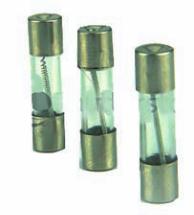
What is a fuse?
A fuse is a common type of circuit breaker
that contains a thin wire, which melts
1
to break the circuit when excess current
flows. It is always placed in the live lead
2
of the supply. It is designed to burn out
and break the circuit if too much current
flows. This should prevent damage to the
appliance. The following electrical power
equation is normally used to calculate the
fuse value:
P = V x I
where P is the electrical power in watts,
V is the applied voltage in volts and I is
the current flowing in amps. The fuse value
must be selected so that it just exceeds the
calculated current.
1
melts
: turns from
solid to liquid, dissolves
2
lead
: wire, cable
TASK 5
Solve the problem given, completing the missing
parts.
We want to make an electrical system safe
using a fuse.
•
A 2 kW hair dryer is to be used
on a 230 V mains supply. What
fuse should be used?
Select from 1 A, 5 A,
10 A, 13 A.
Procedure:
•
To find the current that
flows through the fuse and
the hair dryer, we use the
equation: P = V x I: therefore
I = P / V, that is
.................
= 2000
W / 230 V, and eventually is I = 8.7 A.
•
Now, state what fuse is the most appropriate from
the options available. The fuse is
.................
.
•
Check your results with the rest of the class.
Results:
1.
By doing this calculation we are able to see the
relationship between
.....................................
and current.
2.
When choosing a fuse we have to use the one that
can prevent the user getting electric shock and that
may damage the appliance; indeed if there is a fault,
the fuse wire
.....................
due to the heat generated
by
........................
current flowing through it
1
.
3.
The wire in the fuse
.........................
, isolating the
supply of electricity to
.........................
.
Conclusion:
In conclusion we have learned how a fuse works to
make a circuit safe.
1
the human body has a high resistance when dry but
a current flow of 100 mA (0.1 A) is sufficient to kill
the average person. Obviously, a fuse will not protect
against this. Most modern circuits are protected by
Minature Circuit Breakers (MCBs) for overload
protection and by a Residual Current Device (RCD) –
which is sometimes called a Residual Current Circuit
Breaker (RCCB) – for earth leakage protection. When
a person inadvertantly touches a live electrical cirucit,
that person is providing a path to earth which is
recognised by the RCD which isolates the circuit. Most
RCDs are rated at 30 mA or 40 mA which is considered
low enough to prevent a person from getting a fatal
electric shock (they will still experience an electric
shock but the RCD reacts within milliseconds)
Progetto FOR ELECTRONICS_unit_1.indd 33
10/01/