Basic HTML Version











182
E@W
STEP
Read & Speak
Imagine you are a tour guide. What would you answer
tourists who ask you the questions on the next page?
Skim the three extracts for information.
1
gu i de
a
The origins of Venice date back
to the obscure years of the late
Roman Empire, when the Veneti
fled to the islands of the lagoon
between the Adige and Piave rivers to
escape from the invading barbarians,
the Huns in 432 and particularly the
Longobards in 568. They established
a federation legally dependent on
Byzantium, which in 809 was granted
the status of Free State with a doge at
its head. In 828 it gained prestige with
the importation of the relics of Saint
Mark, and from then on it was known
as the Republic of Saint Mark.
From the early days its form of gov-
ernment was a closed oligarchy, with
the dogate and principal offices in the
hands of a small circle of aristocratic
mercantile families.
Looking towards the Adriatic and
the east, Venice naturally became a
trading city with contacts with the
Byzantine and Arab world. Trade,
and the power of the merchant fleet,
led to the acquisition of an empire.
The first steps were taken in the
11th century. After driving back the
Arab invasions and having eliminated
the Croat piracy in the Adriatic Sea,
Venice started its political expan-
sion towards Istria and Dalmatia. The
Fourth Crusade (1202-1204) enabled
Venice to found a vast
colonial empire in the
Balkan peninsula. Later
Crete (1212) and Cyprus
(1489) and a series of
trading fortresses in the
eastern Mediterranean
were added. Expansion
also took place inland, particularly
in the 14th and 15th century: Ven-
ice conquered the whole of Venetia,
Friuli, Brescia and Bergamo. Having
commercially defeated its rival city,
Genoa, Venice became one of the
greatest powers in Italy, controlling
nearly all trade to the East
and growing fat on profits.
Venice’s decline started
after 1453, with the Fall
of Constantinople and
Columbus’s discovery of
America, which diverted
trade from the Mediter-
ranean to the Atlantic.
The longest-lived repub-
lic ceased to be impor-
tant in European politics
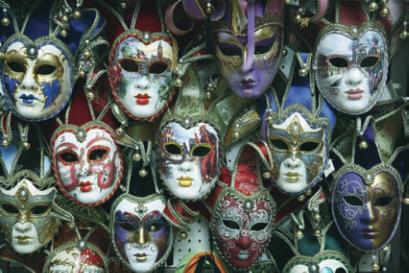
in the 16th century. From
the mid-17th century it
became the centre
of carnivals, masques
and entertainments
for the wealthy and those on
the Grand Tour. In the 18th
century the Habsburgs, eager to
unify the Tirol and Milan, became
Venice’s new mortal enemy, but
they did not manage to conquer
it until the Campoformio Treaty
(1797), when Napoleon ceded it
to Austria in exchange for Milan
(1797-1805). After 1813 Venice
remained in Austrian hands until
1866, when it was annexed to
the newly born kingdom of Italy.
b
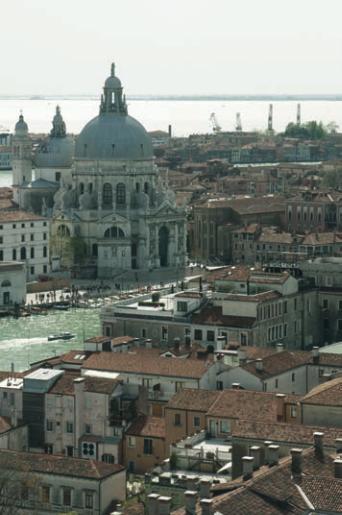
Venice is a museum town.
Every year, thousands of tourists
are attracted by the unusual loca-
tion, romantic history, remark-
able buildings and wealth of art of this
magical city.
Though one third of its inhabitants
now live on the mainland, Venice
was originally built on islands. There
are 117 islands within the lagoon, of
which Rialto is the largest. It is only
since the mid-19th century that Venice
has been attached to the mainland,
first by a causeway for the railway,
and later by a motor road.
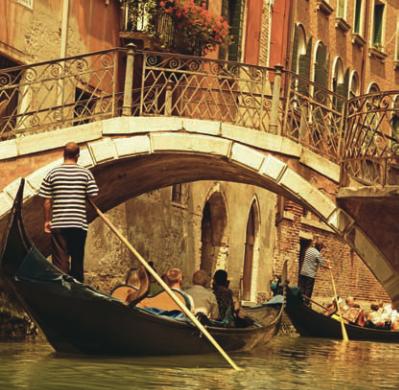
It is one of Venice’s unique charms
that there is no motor traffic, except
on the canals where water buses
have largely replaced the picturesque
gondolas. The main artery or highway
is the Grand Canal, approximately
3.8 km long and in the shape of a
reversed letter S. It is crossed by three
bridges, the oldest being the Rialto
Bridge with its many picturesque small
The charm of Venice
Sez3_U10_180_206.indd 182
02/01/1