Basic HTML Version



98
Retaining key employees in times of change
M
any companies approach the
retention
of key
employees
during periods of
organizational change
by giving financial
incentives to
senior executives
or
star performers
. However, the
money is rarely well spent. Many of the
recipients
would have stayed
anyway; others have
concerns
that money alone can’t address.
Moreover, companies often
overlook
those “normal” performers who
are nonetheless critical for the success of any change effort. There is a
better and less costly approach to employee retention – and one that
will serve companies well as they restructure and reorganize. It starts
with identifying all key players, but
targeting
only those who are most
critical and most at risk of
leaving
. These people are then
offered a mix of financial and nonfinancial incentives adapted to
their aspirations and concerns. What follows are three suggestions
for companies with similar hopes of keeping their top talent without
breaking the bank
.
1.
Find the “hidden gems”
Human resources managers
need
to work together during times of major organizational change to
identify people whose retention is critical. Yet often companies
simply consider high-potential employees; few look for more
average performers
whose skills or social networks may be critical.
These “hidden gems” might be found anywhere in the company:
for example, the
product-development manager
who is nearing
retirement
age and no longer on the company’s list of “high
potentials” – yet who is crucial to ensuring a healthy production
process. The key is to view each employee through two lenses: first,
the impact his or her departure would have on the business, given
the focus of the change effort and his or her role in it; and second, the
probability that the employee in question might leave.
2.
Mindsets
are important
Uniform retention packages are usually
unsuccessful in persuading a diverse group of employees to stay.
Effective employees retention
strategies require a mix
of financial and nonfinancial
incentives.
Curiosity
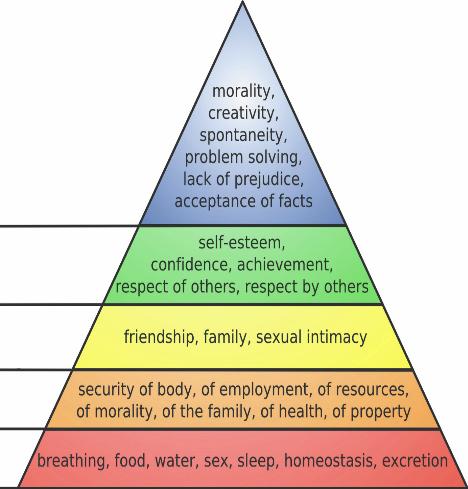
As retention has a direct relationship with employees’ needs
and motivation, the application of a motivation theory model,
such as Maslow’s Hierarchy of Needs, may be used to design
a retention protocol. Organizations have been employing
strategies to stimulate each of Maslow’s five humanitarian needs
–
1
physiological,
2
safety,
3
social,
4
esteem, and
5
self-actualisation – to optimize retention rates. When applied
to the organizational model, meeting the self-actualization
and esteem needs of an employee tend to correlate to better
retention. Physiological, safety, and social needs are important
as well, however, and must be addressed to better the work
environment.
Adapted from
: http://en.wikipedia.org/wiki/Employee_retention
Glossary
Retention
: mantenimento (il trattenere i propri dipendenti)
Employees
: dipendenti
Senior executives
: alti dirigenti
Star performers
: individui con prestazioni elevate
Organizational change
: cambiamento organizzativo
Concerns
: preoccupazioni
Overlook
: trascurano
Recipients
: destinatari
Leaving
: lasciare (l’azienda)
Targeting
: focalizzarsi su
Breaking the bank
: “sbancare”, mandare in fallimento
Human resources managers
: responsabili delle risorse umane
Product-development manager
: responsabile per lo sviluppo
dei nuovi prodotti
3
2
1
4
5
Unità_B.indd 98
31/01/